The road trip is a core American experience. Automobile travel is an intimate, personalized, and self-paced enterprise enabling boundless freedom to roam the expanses. The United States claims the most profuse border-free road network in the world, and its use by citizens is nearly universal. Even the leader of the free world has taken part in this great din of individualized motor-bound culture.


 Harry S Truman: presidential-grade road-tripper.
I recently had chance to read
Harry Truman's Excellent Adventure: the True Story of a Great American Road Trip by Matthew Algeo. The book explores a unique juncture of history when the man who helped win World War II, rebuild Europe, and deliver America into the Cold War left office to take the only post-presidential road trip in history. When the wheelman-in-chief and first lady left Missouri to see family and friends in Summer 1953, they went without the now-common luxury of private planes or Secret Service details. They humbly packed into Harry's own Chrysler New Yorker and added 2,500 miles to the odometer, much like any other couple on holiday to see New York City or Washington, D.C. Though life before presidential pensions made it a journey of affordability, he was a genuine fan of the open road, too.


 As author Matthew Algeo finds, Harry Truman fully embraced the automotive age.
One might call Harry Truman a man cut from the same cloth as any Ozarkbahner. He was the president born nearest the Ozarks - in
Lamar, Missouri - a town that lies in the transition between the hills to the South and the plains to the North. Truman was highly literate and a fan of history, but liked driving just as well. As Algeo quotes him, "I like to take trips - any kind of trip. They are about the only recreation I have besides reading." Truman was a bit of a gearhead, and even made his early political career campaigning for better roads. Consider me a fan.
[
"The Man Who Loved Roads" - U.S. Department of Transportation]
Harry Truman's Excellent Adventure introduces us to the unique and colorful world that the Trumans would have seen in their journey, a daily roster of novel hotels and greasy-spoon diners. Surprised and curious gawkers met them at every pit stop, and Algeo retraced their route for the book, interviewing many who encountered the president along the way. In addition to some interesting detours into the personality and politics of Truman and company, Algeo uncovered a lamentable degree of commercialization and sanitization that has overwhelmed roadside character. Though many shoddy dive restaurants and inns have thankfully shuttered since the 1950s, much of the unique roadside flavor has disappeared, too. Truman's fascination with the automotive age is shared far less today, a reality attributed in part to the homogenization of sights along the way.
In the spirit of good old fashioned car travel, I took my own road trip last Summer, visiting the birthplace and final resting place of Harry Truman in the same day.


 Truman Birth home: humble beginnings for success.
Life for Harry began in modest surroundings, a compact 19th-century home featuring neither electricity or running water. A few blocks from downtown Lamar, the property is now thoughtfully preserved in a state nearest the time of his birth. The first floor contains a diminutive main room, kitchen, and bedroom, with a steep and narrow set of stairs leading to the master bedroom above. Quaint quarters compared to the White House.


 Downtown Lamar, Missouri.
[
Missouri State Parks: Harry S Truman Birthplace Historical Site]
Truman attended the site's dedication as a state park in 1959, complete with inaugural signature in the visitor registry, now on display. The frugal birth home is a keen reminder of the remarkable fortunes enjoyed by both Truman and Americans in general since the late 1800s.


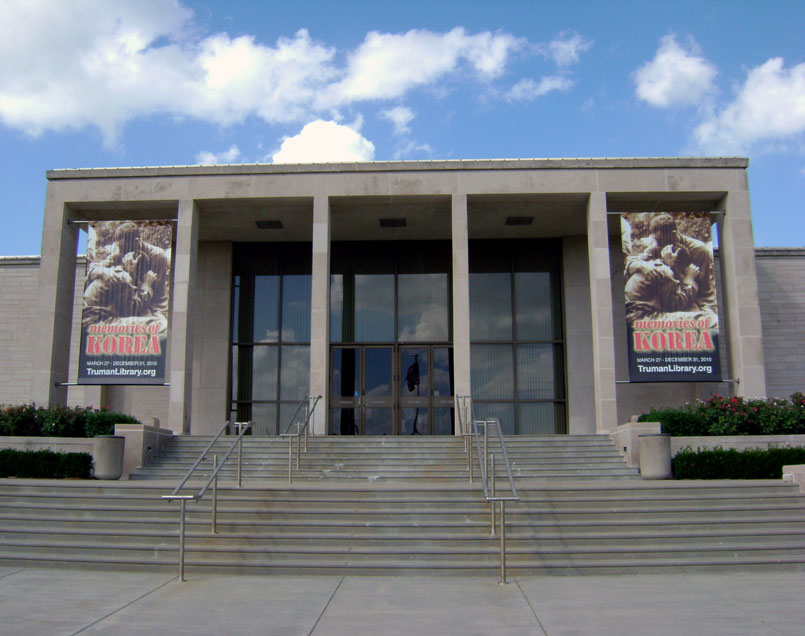
 Harry S Truman Library and Museum in Independence, Missouri.
[
Truman Library official web site]
For most of his life, Truman resided in Independence, Missouri, on the Eastern side of Kansas City. The town is the home to this trip's other destination, the Harry S Truman Library and Museum. According to Algeo, Truman shunned self-promotion out of office and only allowed exhibits on his life with some coercion.


 Post-war prosperity boomed in some quarters, but so did the red menace, real or imagined. Red Scare coal-stirrers like Richard Nixon were among the few individuals Harry Truman genuinely loathed.
Truman understood the magnitude of presidential history, and was more concerned with building a thorough research facility for generations to come. Unlike most contemporary ex-presidents, he refused the promise of substantial profit from commercial and speaking opportunities, feeling they would cheapen the prestige of office. Raising funds for a quality library held more noble appeal.


 Weighty decisions had to be made throughout the Truman presidency, which was marked by conflict: World War, Cold War, and Korean War.
The library is consistently Truman-esq: a classy and historically thorough presentation, but a facility that is not obnoxiously flashy or overwrought. It's appropriate for someone who entered the international scene in a whirlwind as a relatively unknown figure, replacing the iconic four-term Franklin Roosevelt at the most pivotal point in the 20th-century. From county politics in the 1920s to charting America's path through into the Cold War in the 1940s, the breadth of study is enormous.


 Truman's museum bears his legacy and his final resting place.
Sometimes interesting Americans are discovered on drives, but few are known for hitting the road themselves. The sum of my day trip and reading was the discovery of America's citizen president. Harry S Truman was a milestone statesman and loyal husband from the time when any Missouri farmer could be president and few could deny the charm of the
Great American Road Trip.




 Posts
Posts